
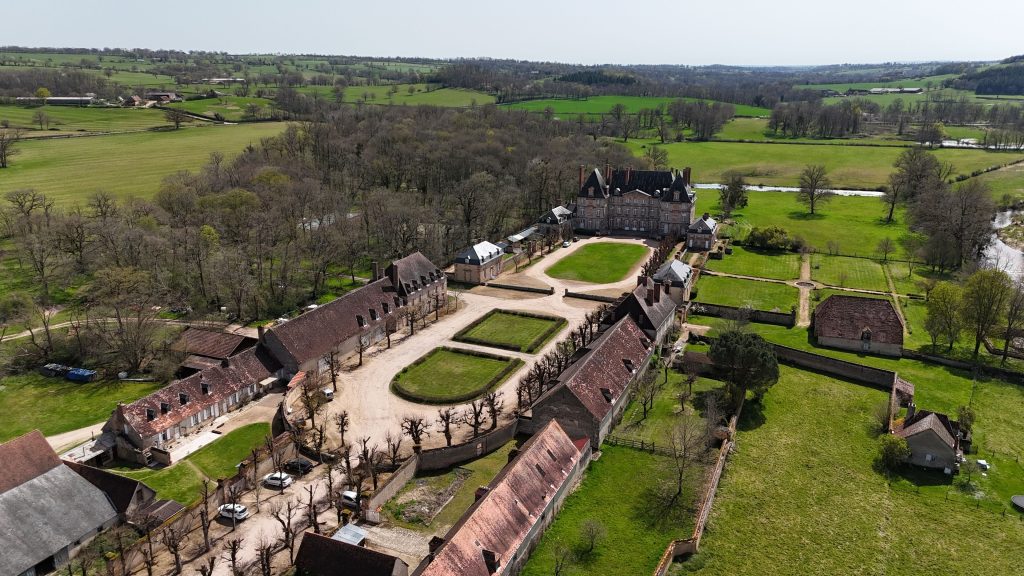
In the 1770s, an architect to the King leaves the splendour of Versailles to remodel a Bourbonnais house. His work at Le Creux reflects a sober, controlled classicism.
An architect to the King
Nicolas-Martial Foacier belongs to that generation of architects trained on the great royal building sites. Versailles is not only a palace: it is a school, where a grammar takes shape (proportion, symmetry, restraint in ornament) that would spread across 18th-century France.
The works at Le Creux
It was François-Marie de Fougières, sub-governor to the children of France, who called upon him. The medieval house was deeply remodelled: a raised central block, a triangular pediment, projecting wings and mansard pavilions enclosing a court of honour.
A measured elegance
What strikes you at Le Creux is not ostentation but rightness. Foacier transposes the rigour of Versailles to the scale of a family home: local stone, slate, regular bays, clean lines.
A living legacy
Two and a half centuries later, the château still bears Foacier’s signature. Restored by Edmond Duthoit at the end of the 19th century, it has kept its original design.