The Château du Creux is a family home, not a museum. What sets it apart is that the same family line has held it since the 14th century, passed down through inheritance and marriage: from the La Faye to the Fougières, from the Fougières to the Nicolay.
In the 14th century, the fief of Le Creux was held by the La Faye family; on 29 December 1407, Hélion de La Faye paid homage for it to the Duke of Bourbon. In 1519, Jeanne de La Faye married Gilbert de Fougières, who in 1546 acquired the land and lordship of Le Creux from his brother-in-law. From then on the estate remained with the Fougières, almost without interruption: it was one of them, François-Marie de Fougières, sub-governor to the children of France, who brought Nicolas-Martial Foacier to Le Creux in the 1770s. His son Louis-Joseph, sent into emigration at the age of twelve in 1791, recovered the estate in 1802; his only daughter, Adélaïde-Hyacinthe, married the Marquis Christian de Nicolay in December 1837, and their descendants still live in the château. Three names in seven centuries, passed from one to the next through marriage: it is this way of handing down, more than the length of time itself, that sets Le Creux apart from châteaux bought and sold as successions came and went.
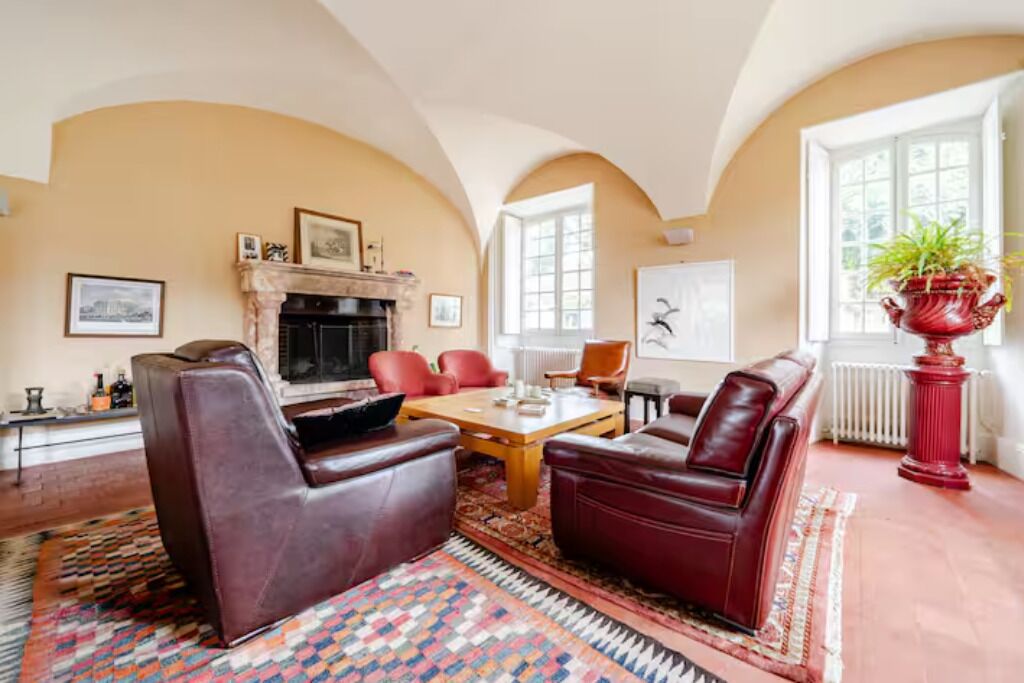
Staying at Le Creux means being the guest of a living house, not the visitor of a frozen monument. The drawing rooms have been lived in by the same families for centuries; the park is kept as it always has been; the library holds books that no one has yet found the time to catalogue in full. The furniture, gathered in the 19th century after the sales of the Revolution, has for the most part never left the rooms for which it was chosen, which gives the interiors a coherence that reconstructed furnishings could not imitate.
It is this presence, discreet and attentive, that makes the difference: here one does not visit the past, one stays within a story still unfolding. The present owners, direct descendants of the House of Nicolay, live at the château all year round and share part of their home with their guests, without playing the part of extras in period costume. Comfort has been modernised (heating, bathrooms, internet connection) without erasing the 18th-century character of the rooms concerned.
Opening a family home to guests raises a question that few château owners answer in the same way: where should the line fall between private rooms and those that are shown? At Le Creux, that line is clear and stable from one season to the next. The family’s private apartments remain closed to guests in all circumstances, for guest rooms as for private hire. The reception rooms, on the other hand, open according to the chosen formula: widely for a private hire that empties the château of any other activity, more occasionally for a guest-room stay, while family life carries on alongside. This arrangement, designed above all to keep the house liveable in the long term, explains why some requests cannot always be met: the house remains a home before it is a venue. This priority is not negotiable, whatever the size of the booking.
In French genealogical vocabulary, a “maison” (house) designates a noble family identified by its surname, passed down primarily through the male line but able, as at Le Creux, to pass through a daughter when the male line dies out or a marriage provides for it. The House of Nicolay thus received the Château du Creux in 1837, not by purchase but through the marriage of Adélaïde-Hyacinthe de Fougières, Louis-Joseph’s only daughter, to the Marquis Christian de Nicolay. The name can be found today in several parts of the estate, including the suite that bears it in the Maison du Régisseur. Bearing an old family name exempts no one from the upkeep a listed house demands: it is a handing-down of responsibilities as much as of heritage, with its share of roofs to redo and quotes to compare, far from the image of an inheritance content merely to exist.
Seasonal news from the Château, a few times a year.