On fragmented land, walked-up shooting lasts ten minutes before the first property boundary. At Le Creux, it lasts all day.
It is not a question of standing. It is a question of geography. Walked-up shooting is one of the rare shooting practices where the quality of the land matters above everything else: above the number of birds released, above the quality of the dog, above the experience of the shooter. Below a certain threshold of area in one block, the practice loses its meaning. It becomes a succession of half-points, forced recalls, giving up at the edge of a field that is not yours.
What walked-up shooting is
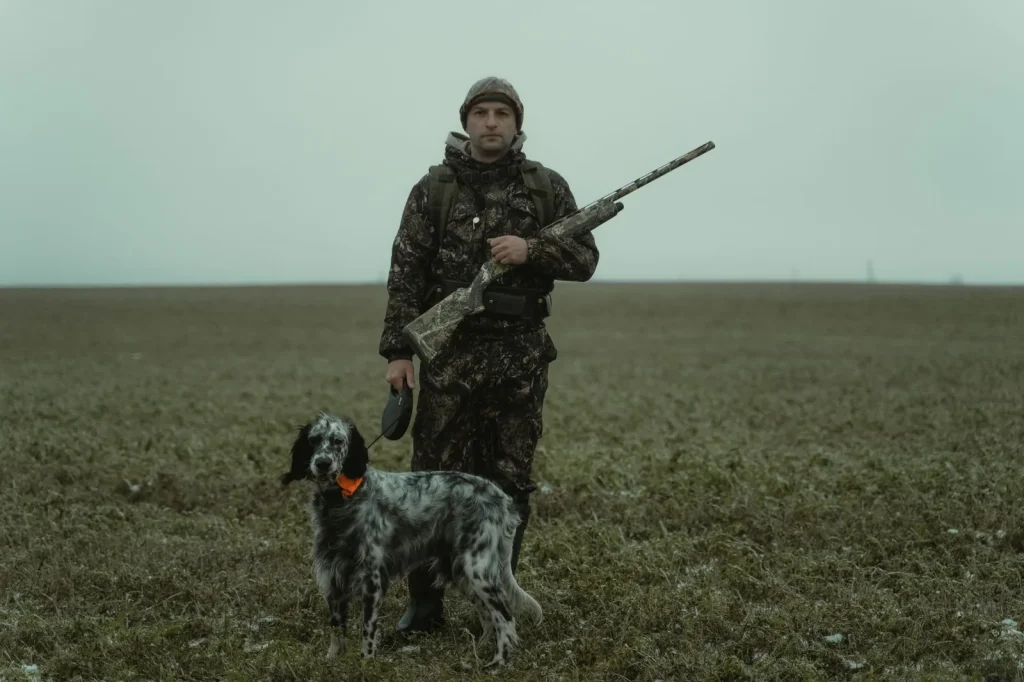
Walked-up shooting, also called shooting over pointing dogs, has nothing to do with a driven shoot. No beaters, no line of guns standing at pegs. One gun or a small group of two to four, moving through the cover behind the dog. The dog works ahead, nose in the wind or nose to the ground depending on the breed, and locates the game. When it points, the gun approaches. The bird flushes. You shoot or you don’t.
The point is the central moment of this kind of shooting. The dog freezes. Body taut, one foreleg raised, eyes fixed on the cover. The silence that precedes the flush sometimes lasts ten seconds, sometimes a minute. That is why you shoot walked-up.
The dogs used are mostly pointing breeds: braque, Brittany spaniel, Irish setter, pointer. Some estates also host moderate-paced flushing dogs for woodcock. In every case, the dog works in constant contact with the gun: it must never be more than a hundred and fifty metres away, or it loses contact and misses the flush.
This practice demands space. A great deal of space. And continuity.
Why is the land the condition for everything?
Fragmented land is land where the cover is interrupted every two hundred metres by a property boundary, a road, a cultivated field that cannot be shot. The dog works well, points at the edge of a promising hedge and the gun has to call it back because the hedge belongs to the neighbour. You start again. Two hundred metres further on, the same scenario.
In the Bourbonnais, private estates are often made up of several non-contiguous parcels separated by tenant-farmed agricultural land or communal woods. The shooter who rents a day on this type of estate spends as much time going round boundaries as shooting.
The Le Creux estate covers 1,100 hectares in one block. That is the first condition. Bocage hedges follow one another without interruption over several kilometres, linked by alder stands that run along the Aumance. The dog can work a whole morning without its handler having to call it back over a boundary.
The structure of the Bourbonnais bocage is particularly suited to this kind of shooting. Thick hedges of hawthorn, blackthorn and hazel offer dense cover where the pheasant willingly holds. The edges between meadow and wood create transit zones that the grey partridge frequents at dawn. The wetlands along the Aumance hold woodcock on migration from October to December.
It is one of the rare configurations of this kind still available in the Bourbonnais. Fragmented land ruins a shooting day: the subject deserves to be laid out clearly before booking anything.
The species: behaviour in front of the dog
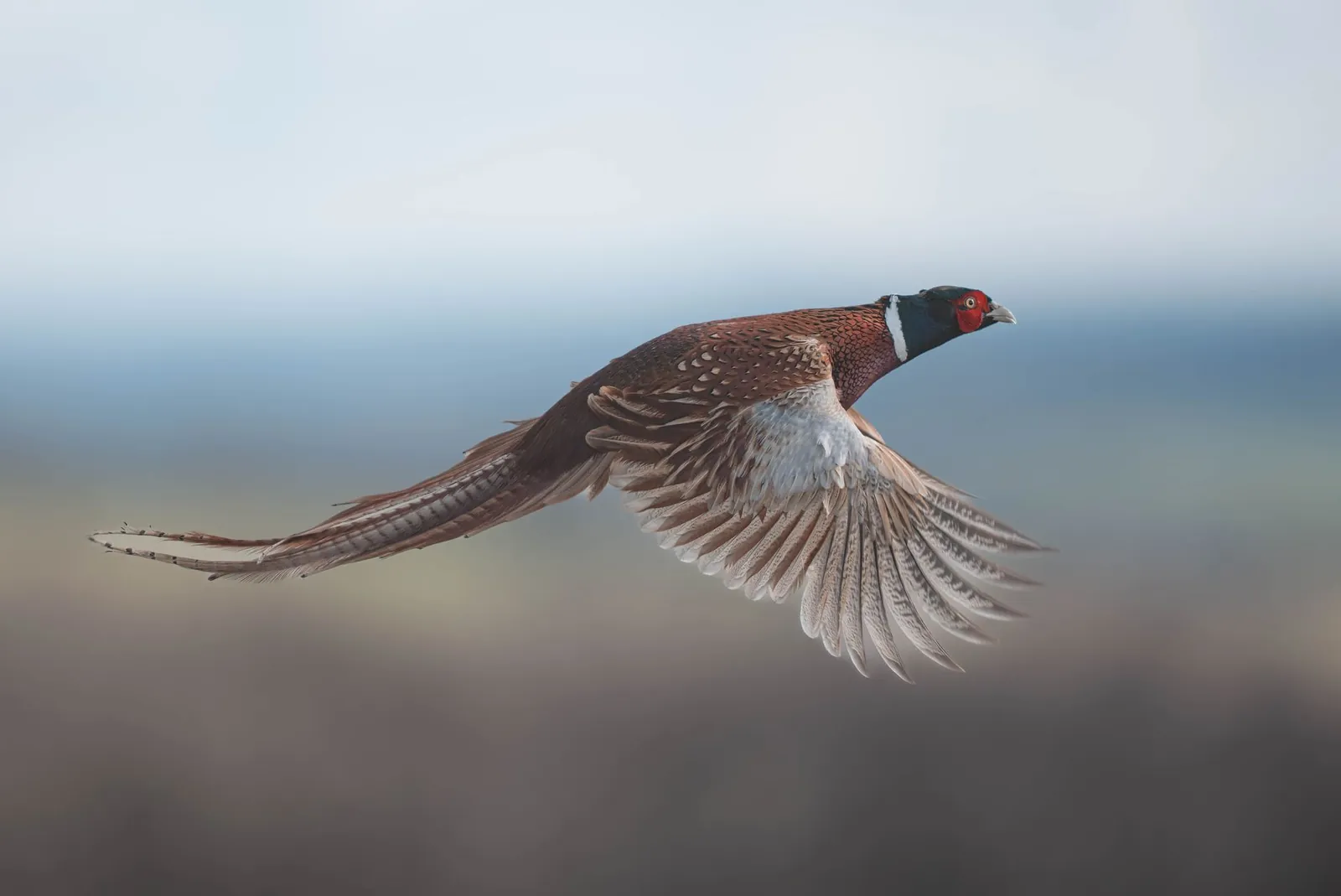
The common pheasant is the most present species on the estate at the start of the season. It readily runs rather than holding the point. A well-trained dog goes round it, pins it against a natural obstacle, a dense hedge or a pile of branches, and forces the flush. The cock pheasant, once flushed, gains height and flies straight for fifty to sixty metres before dipping. The shot is clean and readable.
The grey partridge is more delicate. It holds the point better than the pheasant but flushes as a covey: when one partridge goes, the others follow within two seconds. The gun has to choose its bird before the flush, which means being in position as soon as the dog points. The partridge frequents the edges of meadows, often in the open in the morning when it warms up, then goes back into cover by nine.
The woodcock is the most sought-after species for lovers of walked-up shooting. It arrives on migration from late October, depending on weather conditions in northern Europe. It holds in wetlands, under alders and willows, where the ground stays soft. It flushes silently, spirals up between the branches and disappears. The shot is short, often under twenty metres, in cover that obliges you to let the dog point for a long time before approaching. This year, the first wave is expected in early November if Scandinavian frost conditions are confirmed.
The day at Le Creux: what actually happens
The meeting time is eight o’clock. The October air smells of wet earth and crumpled leaves. The estate’s keeper presents the day’s shooting plan: two or three sectors of cover, an order of passage, the areas to avoid so as not to disturb the resident game before its time.
The first sector is generally the east edge, where the bocage hedges run down towards the Aumance. The dog works fast in the dew. The light is still low at this hour, it crosses the hedges horizontally and lights every blade of grass. The first point often comes within the first twenty minutes.
The morning takes in two sectors. The rhythm is that of the dog and the cover, not that of a timetable. You walk. You stop. You wait. You walk again. For a small group of three guns, allow six to eight kilometres over a morning, depending on the density of the cover and the number of points.
Lunch is served at the château around one o’clock. The morning’s bag is laid out. You eat. The afternoon resumes around two thirty on a different sector, often more wooded, for woodcock if the season allows.
The keeper is present in the field, available but discreet. His role is not to run the shoot in place of the guns: he knows the sectors, knows where the game held the day before and can steer without imposing. For groups coming for the first time, this knowledge of the ground saves two hours over the day.
The bag at the end of the day depends on the cover, the weather and the dog. We do not sell a guaranteed number of head. This is not that kind of shooting. Walked-up shooting is nothing like shooting game released in advance in front of the guns. If that is what you are looking for, the driven shoot on this same land follows a different logic.
Organising your day
Walked-up days at Le Creux are organised for small groups, three to five guns at most. The season runs from September to the end of January depending on the species. September and October weekends go first. The next available slot is the weekend of 26 September 2026, which offers a feathered-game format with accommodation on site.
For practical details and conditions of welcome, our page on shooting gathers the season information, the species present and the booking arrangements.
The estate does not have a shooting lodge in the strict sense. You sleep at the château, you dine at the same table in the evening. It is a deliberate choice. Some seek it out. Others prefer a purely sporting provider, and that is entirely understandable.
