
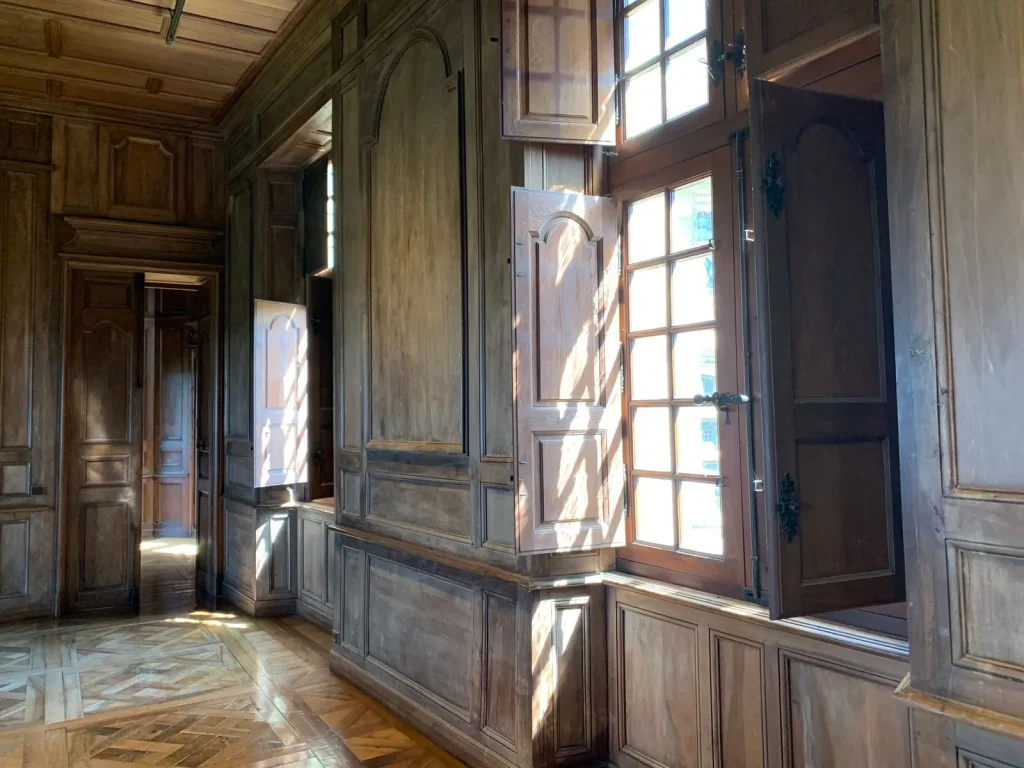
It is six in the morning. The walls are eighty centimetres thick. No air-conditioning noise, no hum from a minibar. The light comes in from the east, filters through 19th-century blown glass and draws slightly distorted rectangles on the oak parquet. That is what a night in a house listed as a Historic Monument concretely changes.
Not a promise of escape. A fact of construction.
What listing changes on the stone side
A Historic Monument listing does not mean that the place is beautiful. It means that the State has judged that the materials, the structure and the interior arrangements deserved to be preserved as they were. A direct consequence for anyone who sleeps here: nothing has been lined with plasterboard, nothing resurfaced with resin. The tufa and granite walls of the Château du Creux naturally regulate humidity and temperature. In July, the room stays at nineteen or twenty degrees without air-conditioning. In November, the heat of the Volvic-stone fireplace builds up and lasts until the next morning.
The flip side exists. You cannot drill through a wall to install an extra radiator without authorisation from the Regional Directorate for Cultural Affairs. A crack in a window lintel calls for a heritage architect, not a local mason. The château has no spa, no jacuzzi in the rooms, no gourmet restaurant of its own. People come for something else: thickness, the density of the air, permanence.
The night, room by room
The Nicolay Suite occupies the north-west corner of the wing remodelled in the 1770s by Nicolas-Martial Foacier. The ceiling reaches three metres forty. The panelling, painted linen grey, dates from the same campaign of works. At night you hear the owls in the park. Nothing else.
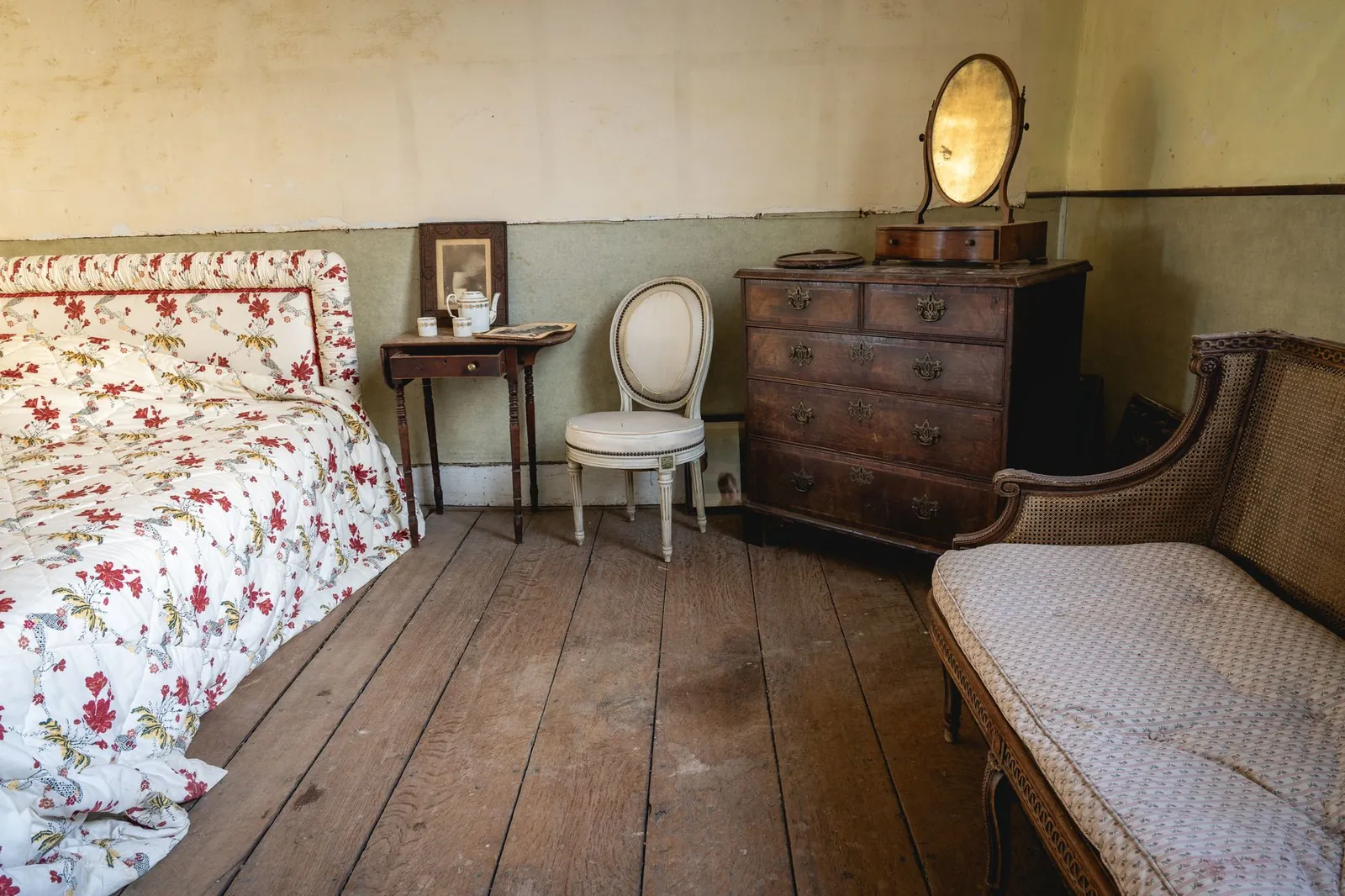
The Bourbon Room looks east over the orchard. In summer, the sun comes in early and strong. It is a room for those who get up before seven. The Fougières Room, further south, keeps a soft light until late afternoon. The parquet there shows a pale trace in front of the fireplace: the passage of two centuries of soles, at that precise spot.
The Aumance Cottage is an option apart: an independent outbuilding, on the edge of the estate, for those looking for complete privacy rather than life in the château. Not a converted maid’s room but a separately built volume, with its own access onto the estate.
Why is the acoustics of a listed house worth talking about?
In a contemporary hotel, sound insulation is a technical performance measured in decibels. In a house of this thickness, it is an accidental consequence of the construction. Eighty centimetres of limestone rubble between the courtyard and your ear is like nothing else.
The silence here is not an absence of sound. It is a texture. You make out gravel underfoot in the courtyard, wind in the park’s lime trees and sometimes, in winter, wood working in the attics. Nothing like the dull hum of a building.
Do you sleep better in a listed house? The question deserves an honest answer. Some guests find the silence unsettling for the first two nights. Others leave only reluctantly on the third morning. Acclimatisation exists, as with any kind of altitude.
What Foacier designed for summer nights
Nicolas-Martial Foacier, best known for his work at Versailles in the 1760s, introduced at Le Creux a logic of orientation that the 20th-century renovators did not alter. The main bedrooms face east or south. The service corridors, north. The passages, west, to catch the evening light without the heat of the afternoon. In summer, this arrangement is enough. No bedroom window takes the full west sun at the end of the day. It is air-conditioning by plan, not by machine.
For stays linked to a wedding or to private hire of the château, the rooms and suites form the base of the on-site accommodation. Practical details of capacity and organisation are on the Stay page.
A house lived in since the 16th century
Five centuries in the same family. This is not a presentation formula. It is the reason why the parquet of the Nicolay Suite has been waxed every autumn since it was laid at the end of the 19th century. It is also the reason why a portrait of François-Marie de Fougières, who commissioned Foacier’s works, still looks down the first-floor corridor from the same nail.
You are not born into a house of this age knowing how to pass it on. You learn it, generation after generation, through sometimes uncomfortable decisions: giving up a modernisation because it would damage a floor, funding a roof restoration before redoing a bathroom. The guest who sleeps here sleeps in the result of these accumulated trade-offs.
If you are considering a stay, the simplest thing is to check the rates and availability online and to give your dates. The conversation will start from there.
